Ecology at Taizé
Introduction
Although the terms “ecology” and “sustainability” have only been in use since the 1980s and 1990s, the Taizé Community has been committed to preserving nature since its inception. Today, young people are increasingly reflecting on issues related to climate, biodiversity, and social justice, as well as other contemporary challenges.
We brothers would like to share examples of what we can all do ourselves, in our daily lives and inspired by our faith.
By the simplicity of our community life, we want to show that people can be happy with very little. To that end, we offer workshops throughout the year to explore the connection between ecology and faith, and we include intercessions during our community prayers concerning the care of creation.
Water Supply and Treatment
Without water, it would not be possible for life to exist on earth... or at Taizé.
To use a buzzword, we could say that the community is “off-grid”—self-sufficient—when it comes to water. In this regard we are entirely self-sufficient.
Drinking Water:
A well was drilled as early as 1949. Efforts are being made to reduce water consumption: we have installed push-button faucets and flow restrictors for showers, sinks, and drinking fountains, as well as push-button flushes for toilets. Despite all these efforts, to accommodate the increase in the number of visitors and ensure a reliable drinking water supply, a second well had to be drilled in 1989.

Wastewater:
After inconclusive trials to treat our wastewater, a digester-settling tank was built in 1975, followed by lagoons in 1982—the first of their kind in the region.
Treatment via lagoons is a biological process capable of accommodating fluctuations in wastewater volume, since there are many more young people in Taizé during the summer than in the winter.
The efficiency of our wastewater treatment plant exceeds 95%, except for nitrogen and phosphorus.
Rainwater:
Rainwater is collected separately.
On the east side of the hill, rainwater is channeled to the pond of the Saint-Etienne spring, which it feeds after undergoing a simple treatment process (sand removal and settling).
On the west side of the hill: after sand removal and settling, the water is used for irrigation and as a water reserve for the fire department.
In the brothers’ living quarters, rainwater is collected and used for flushing toilets.
Energy
The first thing to do when we talk about energy is to use less of it. About fifteen years ago, a major project was undertaken at the Church of Reconciliation: underfloor heating was installed—it is more pleasant to pray on a floor that isn’t cold. The lighting was also upgraded by replacing the 100W bulbs first with 12W bulbs, and now with 4W bulbs. This represents a substantial saving given the large number of bulbs (over 300).
At Taizé, we use gas for heating. It’s important to insulate our buildings well; most of our buildings are gradually being renovated with better insulation, underfloor heating, and new doors and windows.
For hot water, we have installed solar thermal panels. The installation was done by our plumber from Cluny (10 km from here), who also handles maintenance. This illustrates the well-known saying: think globally, act locally.
In 2023, photovoltaic panels were installed on the roofs of the dormitories, facing east, south and west to optimize electricity production as long as possible throughout the day. This system provides about 30% of our annual electricity consumption. We use 70% of the electricity we generate ourselves, and the rest is sold.
Since 2017, we have had a contract with Enercoop, that supplies us with green electricity produced in France.
In the house where the brothers live, heat from the computer servers is recovered to heat the water for the showers.
Waste
Responsible purchasing to minimize waste:
For meals, we are constantly striving to reduce the amount of packaging: yogurt in five-liter buckets, cookies without individual wrappers, and dried legumes bought in bulk instead of canned.

We continue to encourage young people to take only as much food as they can eat.
As for cleaning, dispensers and mixers have been purchased for concentrated cleaning products.
Given the diversity of the countries of origin of the young people who come to Taizé, and the different waste-sorting practices in each country, waste sorting in Taizé remains a challenge. We separate packaging, food waste, cardboard, plastic wrap, plastic items that do not fit into the other categories, paper, and metals.
We also try to reuse materials that would otherwise become waste, such as shredded paper as packing material for shipping
Commitment to biodiversity
For those familiar with Taizé, the Saint-Étienne spring is a place of silence, rest, and meditation.
It is also a place where one can see birds, insects, and a wide variety of plants.
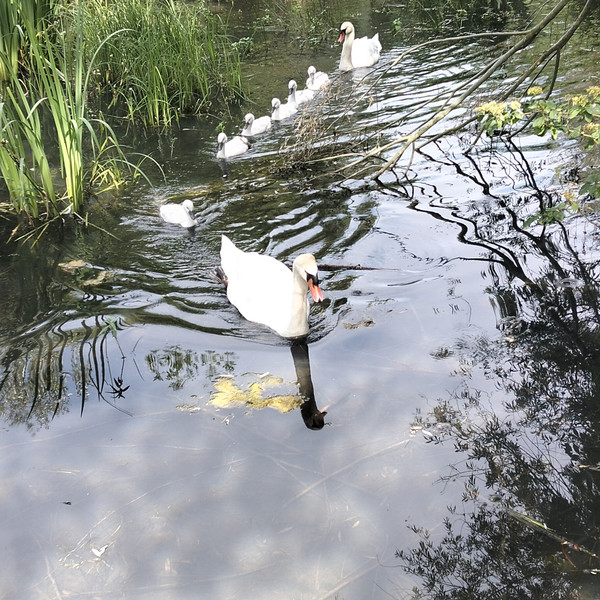
The black locust trees have given way to native species such as field maple, dogwood, hornbeam, and privet. In the spring, wild garlic and lily of the valley compete for the best spot to grow. The pond attracts many birds that are easy to spot, such as ducks, moorhens, coots, and swans. Other visitors are harder to spot: the little grebe, the European golden oriole, and the kingfisher.
Next to the new cemetery, a conservation orchard has been planted: thirty varieties of local apple trees and meters of hedgerows, with financial support from the Bourgogne-Franche-Comté region. We plan to gradually expand this orchard not only with apple trees but also with other fruit trees, such as plum and pear trees.
We have noticed that certain tree species are struggling due to drought, disease, and insect infestations. We are seeking to diversify the species to make them less vulnerable to climate change. Every year we plant new trees to ensure that we have trees of different ages, which are therefore more resilient.
Towards a more responsible mobility
The Taizé Community is working to gradually reduce the environmental impact of its travel. Little by little we are switching to electric vehicles and we prioritize public and ground transportation as much as possible.
Nevertheless, travel—both by young people coming to Taizé and during pastoral visits by the brothers and teams—accounts for about 70% of the carbon footprint of the gatherings organized in Taizé and elsewhere.
That is why we strongly encourage group travel, the use of shuttle services, and carpooling. In the same vein, charging stations for electric cars have been installed on the hill.
